jeudi 4 avril 2013

U.S. initial jobless claims rise by 28,000 to 385,000 last week

The number of people who filed for unemployment assistance in the U.S. rose more-than-expected last week, hitting a 16-week high, official data showed on Thursday. 

In a report, the U.S. Department of Labor said the number of individuals filing for initial jobless benefits in the week ending March 30 rose by 28,000 to a seasonally adjusted 385,000, compared to expectations for an decrease of 7,000 to 350,000.

Jobless claims for the preceding week rose by an unrevised 357,000.

Continuing jobless claims in the week ended March 23 fell to 3.063 million.  Analysts had expected continuing claims to fall to 3.050 million from last week’s revised figure of 3.071 million.

The four-week moving average was 354,250, an increase of 11,250 from the previous week's revised average of 343,000.

The monthly average is seen as a more accurate gauge of labor trends because it reduces volatility in the week-to-week data.

Following the release of the data, the U.S. dollar held on to gains against the euro, with EUR/USD shedding 0.18% to trade at 1.2827.

Meanwhile, U.S. stock index futures remained higher. The Dow Jones Industrial Average futures pointed to an increase of 0.2% at the open, S&P 500 futures indicated a gain of 0.2%, while the Nasdaq 100 futures signaled a 0.2% rise. 
-->

mardi 2 avril 2013

Forex Trading Signals for 3rd April 2013


Japan (Tokyo)                               United Kingdon (London)                        USA (New York)


For more easy access,,,,,,Download our mobile application on your mobile :   Click Fxsignals 


EUR/USD
Trading Range:   1.28500 - 1.27500
Down Trend : SELL
(1) SELL
E/P: 1.28307
T/P: 1.27800
S/L: 1.28700

(2) SELL
E/P: 1.28041
T/P: 1.27700
S/L: 1.28600
 ,
-->

GBP/USD
Trading Range: Trading Range:   1.51500 - 1.50000
Down Trend: SELL
(1) SELL
E/P: 1.50900
T/P: 1.50500
S/L: 1.51400

(2) SELL
E/P: 1.51488
T/P: 1.50500
S/L: 1.51800

Forex - EUR/USD drops as eurozone jobs data misses expectations

The euro softened against the dollar on Tuesday, briefly approaching 4-month lows after data revealed that the eurozone unemployment rate hit an all-time high in February.

In U.S. trading on Tuesday, EUR/USD was down 0.11% at 1.2836, up from a session low of 1.2812 and off from a high of 1.2877.

The pair was likely to find support at 1.2772, Monday's low, and resistance at 1.3048, the high from March 25.

The eurozone unemployment rate hit an all-time high of 12% in February, up from January's original 11.9% reading, which was revised up to 12%.

The numbers sparked safe-haven demand for dollar as did eurozone factory data.

The eurozone’s manufacturing purchasing managers’ index hit 46.8 in March, according to Markit Economics, up from a final reading of 46.6 in February but still below the 50 mark that separates growth from contraction.

The manufacturing PMI in Germany, Europe's economic engine, came to 49.0 in March from a final reading of 48.9 in February, which gave the euro some support.

Across the Atlantic in the U.S., factory orders rose by 3.0% in February, above expectations for an increase of 2.9%, according to the Census Bureau.

The numbers supported the greenback.

Many market participants remained on the sidelines ahead of the European Central Bank’s upcoming policy meeting on Thursday.

While no changes to monetary policy are expected, many remained in wait-and-see mode ahead of ECB President Mario Draghi's press conference that will take place when the policy meeting concludes.

The euro, meanwhile, was up against the pound and up against the yen, with EUR/GBP trading up 0.62% at 0.8488, and EUR/JPY trading up 0.09% at 119.92.

On Wednesday, the eurozone is preliminary inflation data.

In the U.S., payroll processor ADP will release its monthly report on private-sector nonfarm payrolls, often a precursor to the official jobs report due for release on Friday. 

The U.S. is also to produce official data on crude oil stockpiles, while the ISM is to release a report on service-sector activity, a leading indicator of economic health.
-->

U.S. stocks open higher ahead of data; Dow Jones up 0.49%

U.S. stocks opened higher on Tuesday, as markets awaited the release of U.S. factory orders data later in the day, while investors ingnored earlier disappointing economic reports out of the euro zone. 

During early U.S. trade, the Dow Jones Industrial Average gained 0.49%, the S&P 500 index climbed 0.55%, while the Nasdaq Composite index advanced 0.82%. 

In the euro zone, official data showed that the unemployment rate rose to an all-time high of 12% in February compared with an original estimate of 11.9% for January, which was revised up to 12%.

A separate report showed that the euro zone’s manufacturing purchasing managers’ index ticked up to 46.8 in March, from a final reading of 46.6 the previous month, still substantially below the 50 mark that separates growth from contraction. 

Insurance companies, such as Humana and United Health led gains, surging 8.97% and 7.56%, after the Centers for Medicare and Medicaid Services released a final estimated payment growth rate of 3.3% for insurers. 

In February, the government proposed a payment reduction of more than 2%. 

Financial stocks added to gains, as shares in JP Morgan added 0.31% and Bank of America advanced 0.49%, while Citigroup climbed 0.71%. 

Goldman Sachs underperformed on the other hand, slipping 0.20% following reports the U.S. lender registered a fund that invests in risky credit products as a publicly traded business development company, in order to avoid some regulations that would otherwise limit its activity. 

Elsewhere, Apple rallied 0.89%, afterGoldman Sachs removed the iPhone maker from its "conviction buy" list, but still rated the stock a "buy." 

Separately, Apple CEO Tim Cook apologized for the company’s iPhone warranty and repair policies in China. The tech giant had received criticism from state-run media over customer service in its second-largest market. 

In the same sector, Hewlett-Packard plunged 5.71% after Goldman Sachs cut its rating on the tech company to "sell" from "neutral," saying sentiment about the company has moved ahead of reality. 

Oil and gas major Chevron was also on the downside, retreating 0.43%, after the company completed repairs to a central crude distillation unit at its San Francisco Bay-area refinery in Richmond, California, almost eight months after a massive fire struck the core of the plant. 

Across the Atlantic, European stock markets were sharply higher. The EURO STOXX 50 jumped 1.20%, France’s CAC 40 rallied 1.11%, Germany's DAX gained 1.15%, while Britain's FTSE 100 advanced 1.27%. 

During the Asian trading session, Hong Kong's Hang Seng Index rose 0.31%, while Japan’s Nikkei 225 Index tumbled 1.08%. 

Later in the day, the U.S. was to release a government report on factory orders.
-->

Forex - EUR/USD lower after euro zone data

The euro was lower against the dollar on Tuesday after weak data out of the euro zone fuelled doubts over the strength of the region’s recovery in the first quarter. 

EUR/USD hit 1.2825 during European afternoon trade, the session low; the pair subsequently consolidated at 1.2831, shedding 0.14%.

The pair was likely to find support at 1.2770, Monday’s low and resistance at 1.2888, the high of March 26.

Official data showed that the euro zone unemployment rate rose to an all-time high of 12% in February compared with an original estimate of 11.9% for January, which was revised up to 12%.

A separate report showed that the euro zone’s manufacturing purchasing managers’ index ticked up to 46.8 in March, from a final reading of 46.6 the previous month, still substantially below the 50 mark that separates growth from contraction.

Germany’s manufacturing PMI dropped back into contraction territory, falling to 49 in March from a final reading of 50.3 in February, as new orders fell.

Sentiment on the single currency also remained fragile amid concerns over the potential implications of a bailout for Cyprus.

Investors remained cautious ahead of the outcome of the European Central Bank’s upcoming policy meeting on Thursday.

The ECB was not expected to announce any changes to monetary policy, but investors were awaiting comments from President Mario Draghi at the bank’s post-policy meeting press conference.

The euro was higher against the pound, with EUR/GBP rising 0.28% to 0.8459 and edged lower against the yen, with EUR/JPY slipping 0.08% to 119.70.

Sterling weakened after data showed that the U.K. manufacturing PMI rose to 48.3 in March from 47.9 in February, but came in below expectations for a reading of 48.5.

The weak data added to fears over the risk of a triple-dip recession and fuelled expectations that the Bank of England could restart its asset purchase program as soon as this week.

The U.S. was to release a government report on factory orders later in the trading day.
-->

lundi 1 avril 2013

5 Most Predictable Currency Pairs – Q1 2013


Not all currency pairs behave in the same manner: the better ones will slow down when approaching a clear line of support or resistance and will then bounce back. With enough momentum, the pair will break the line and never look back. These pairs are the more predictable ones. However, not all of them tend to follow technical rules that closely.
And as seasons change, so do markets: some become more predictable, while others lose touch with charts. Many factors impact this behavior. Here is a ranked and updated list for Q1 2013 of the top 5 pairs, with each pair’s characteristics.
  1. AUD/USD: The pair might change its direction in Q1 2013 and drop, but it isn’t likely to change in its predictability: it trades in a clear and wide range. Moves within the range were within clear channels, and when these were broken, the impact was clear to see. Stability in China has lowered the volatility but not the predictability. We could see an uptick in volatility in Q1 2013, something that will certainly help technical trades on the Aussie.
  2. EUR/GBP: This popular cross trades very nicely within channels and it has advanced from the third to the second place. The pair tends to check out the limits of the channels before making a big bounce to the other direction. With the UK following Europe in muddling along and with nasty moves in GBP/USD, this pair provides a more smooth ride, especially with the limited trading ranges.
  3. USD/CHF: This seems like a surprising choice, as the SNB maintains a floor of 1.20 under EUR/CHF and the moves in EUR/USD therefore determine the moves in USD/CHF. Nevertheless, this pair behaves in a better manner than all the others mentioned here. Ranges are determined quite nicely, and when a breakout occurs a new trading range is found and traded in. This behavior is likely to continue in Q1, assuming the European debt crisis continues in its current form: managed but not resolved.
  4. NZD/USD: The kiwi falls from the second place after some choppiness – the pair finds it hard to adjust to the high levels. Nevertheless, it is still a very interesting pair which tends to mark the range upon a breakout, and stay within this range for a period of time.
  5. EUR/AUD: Another euro cross closes the list. Long term limits and channels are generally respected, especially on the upside. Both currencies used to trade in tandem, but each has developed its own direction. Together they work quite nicely and will be interesting in Q1.
One  major pair missing from the list is EUR/USD: the world’s most popular pair is almost OK, but not good enough. It has too many false breakouts. The number of risk factors on both sides of the Atlantic is a bit too much.
Another major pair that is missing isUSD/JPY: the pair soared in Q4 but didn’t always respect technical lines, even though it was one of its better quarters. Traditionally, this is a problematic pair.
What do you think about this list? Do you agree? Disagree? What are your favorite pairs?
-->

How About Investing in Forex?


Forex is associated with active trading, very active trading, sticking the nose to the screen. There’s an option to invest in forex trading – not buying a currency and sitting on it, but rather investing your money with successful forex traders that trade for you – the same way as putting your money with mutual funds.
invest in forex
With mutual funds that specialize in stocks, you invest in trusted investment houses. They buy and sell stocks for you, and for others. Good mutual funds outperform the markets. For example, they specialize in S&P or Nasdaq stocks, and have a better yearly yield than these indices.
They enable you to invest in stocks without the hassle of buying and selling stocks by yourself. But not all mutual funds are equal – sometimes they under perform and have a yield lower than the stocks they specialize in.
And sometimes stocks just go down.
In forex trading, there’s always a currency that goes up, rising against another currency. This is one of the main drivers of traders into forex trading. Good traders buy and sell currency pairs in different frequencies, and profit off the changes in prices.
But not everyone is up for active trading.
Forex trading consumes time, and some traders get addicted to it. Sticking the nose to the screen and watching every pip move up or down is too common with traders.
The solution is investing in forex traders who are successful experts. They trade all the time, you automatically follow them and make profits off forex trading without the hassle.
But good forex traders are hard to find.
Yes, some 75% to 95% of retail traders lose money. If you follow the losing ones, you lose money the same way that you lose money with underperforming mutual funds that specialize in stocks.
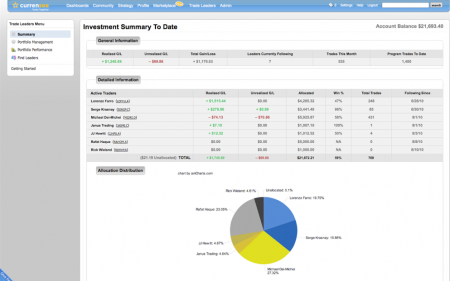
There are quite a few services offering the trader the option to automatically follow traders. My favorite isCurrensee. Why? Not only because I’m affiliated with them. Their program, which is still rather new, is built up of important components that are very promising:
  • The professional traders trade in their own, real, live account. No demo accounts are involved. The leader’s success is your success.
  • Currensee is regulated by the British FSA, one of the toughest regulatory bodies out there.
  • They cherry picked the trade leaders which you can follow – they are ranked not only on their performance, but also on their risk.
  • Trade leaders’ performance is monitored on a daily basis, meaning that profitability is kept high. Profitability is compared with the S&P index.
  • The investor has full control over which traders he follows, sees every single action made by the trade leader (including slippage) , and can change the amount of money invested in every leader easily.
-->